The Jewish New Year begins at sundown on Wednesday evening. Many of you know that I have not been the most ardent follower of Rosh Hashanah traditions over the past handful of years. To give you an idea, longtime readers like Ken and Matt can attest to the fact that I went to temple exactly one time in the 20 years since I've been out in California. But I'm nonetheless fascinated by the Roman Jews and their traditions.
I suppose it's knowing that -- despite my atheism -- I, along with my family and friends who are North American Jews, share cultural links with these Italians that have lasted for all these millennia and across the continents. There is something powerful about going into the bakery in the Ghetto, and struggling to communicate with the gruff women behind the counter in my pathetic verbal morsels of Italian, yet still being able to seamlessly wish each other a happy holiday in the 4 or 5 words of Hebrew that I understand.
In any event, one of the best things about learning a little regarding the Jewish culture in Roma is discovering the different culinary traditions that exist here. One traditional dessert that Roman Jews eat during Rosh Hashanah is a cake called lo storto. I've never seen a lo storto cake or anything like it in an American home during Rosh Hashanah -- and I did go to 2 such dinners every year before I moved to California. Lo Storto is shaped like a half-moon, and is made of almond paste, pine nuts, and raisins. It has a glazed crust. Here's what it looks like:
To give you a sense of scale, this cake is about the size of a football. It's dense too. To be honest, it looks better than it tastes. Unlike the other dolci I've had at the Ghetto bakery, I didn't love this one. But still cool to try it!
If you want more information, Katie Parla has, as usual, written a wonderful piece on the "Roman Jewish Culinary Traditions on Rosh Hashanah." You can read her post -- which includes recipes -- here:
parlafood.com/roman-jewish-culinary-traditions-on-rosh-hashanah/
Tuesday, September 3, 2013
Monday, September 2, 2013
Campo De' Fiori, Giordano Bruno, And The Talmud
This title to this post is not a Jeopardy question. But it could be. The subject here is instead, ultimately, a little-known footnote regarding Jewish history in Roma about which I knew nothing until last week -- even though echoes of it have literally sat before my eyes for 6 months. With Rosh Hashana on the horizon, the discovery is timely. The history is far broader than Jewish history; these are lessons about tolerance and freedom of thought.
The Background:
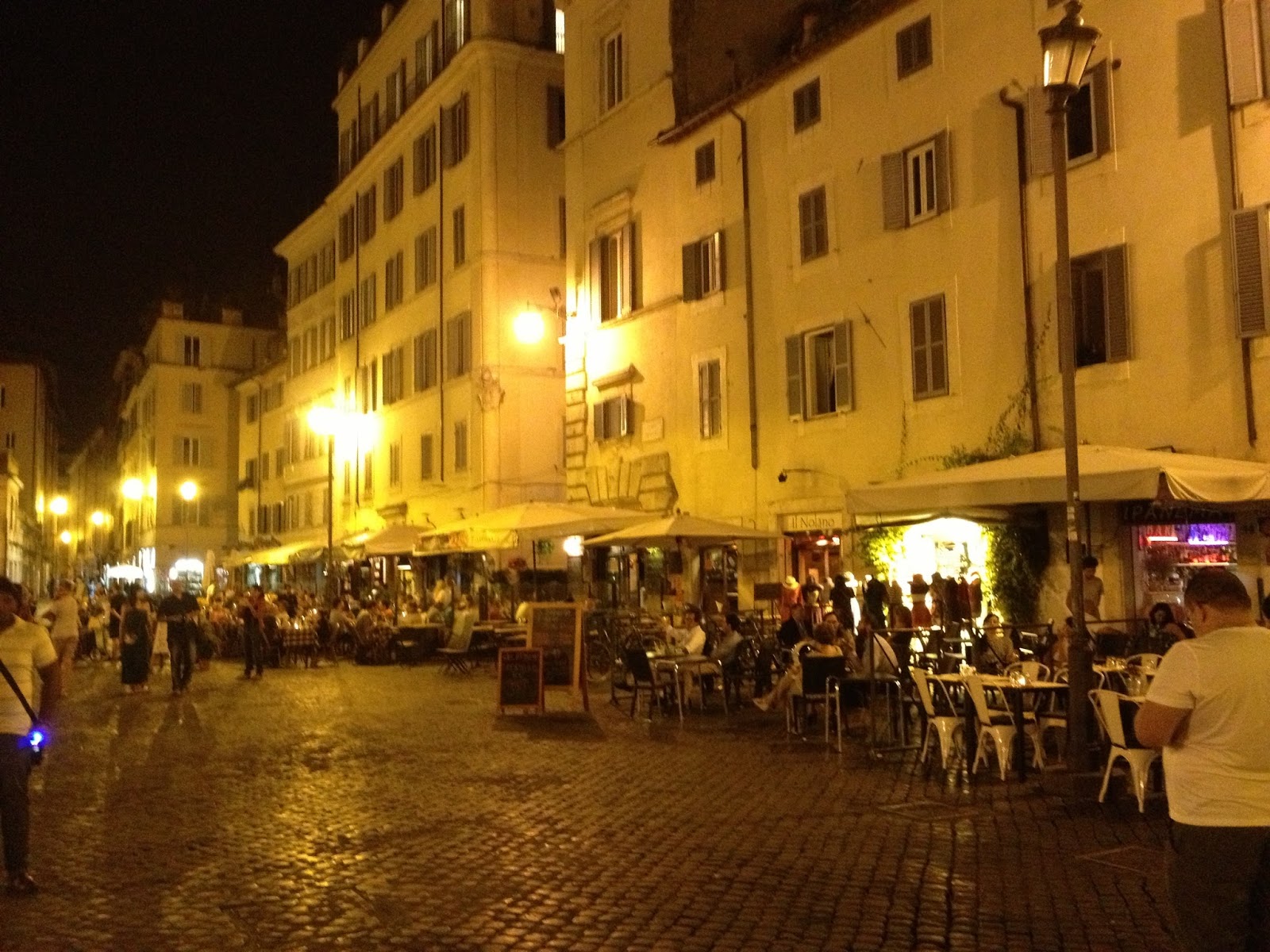
Campo de' Fiori is one of the best spots in Roma. Yes, it's buzzing with tourists. The morning throngs at the fruit and veggies stands are a mix of locals and tourists (perhaps more tourists than locals), and the evening crowds at the cafe/restaurants that line the square also include lots of tourists. But it's fun. For 2 months, I bought my morning fruit there almost every day. And over the past 6 months, I've spent many evenings sitting there with friends and drinking aperol spritzes and/or vino. Great place to just chill and people-watch.
Amidst the light-hearted action and frivolous fun, however, there is somber history. In the center of Campo de' Fiori is this statute. Although everyone who visits necessarily sees the statue, I suspect that most do not know what and who it represents.
The statue is of Giordano Bruno. The inscription at the base of the statue says (in Italian), "To Bruno - from the century predicted by him - here where the fire burned." Bruno's story is chilling.
Giordano Bruno:
Giordano Bruno was a Napoli-born Dominican monk who fled from his monastery in the mid-1580s and wandered around Italy, France, and England. He was brilliant, reckless, charmingly charismatic, and insufferably argumentative. During his stay in England, Bruno wrote a series of strange works that were critical of organized religion. He wrote of the absurdity of organized Christianity -- both the militant Protestantism he encountered in England, and the Counter-Reformation Catholicism from which he'd fled in Italy. He viewed both strains of Christianity as bigoted and narrow-minded. But Bruno was not a melancholy spirit who brooded over his skepticism. The universe as Bruno conceived it was a thrilling place that had the potential for delight and pleasure.
Bruno considered Copernicus a hero. He championed Copernicus' theory that the earth was not the center of the universe. And Bruno took it further. Bruno asserted that there was no center to the universe at all, neither the earth nor the sun. We are a mere speck in this universe, which is a fact that Bruno believed we should embrace with wonder and awe. These were all scandalous and extremely unorthodox ideas.
Bruno's fate might have been different if he'd remained in England -- or in Frankfurt, Zurich, Prague or Wittenberg, the other places to which he wandered. But Bruno decided to return to Italy in 1591. He thought he could find safety in Venice and Padua. He was wrong. The Roman Inquisition had Bruno smack in its cross-hairs. Bruno was arrested in Venice, extradited to Rome, and imprisoned in a papal cell near St. Peter's. The Church charged him with heresy. His interrogation and trial went on for 8 years -- even longer than most U.S. patent cases last, which is bizarre given that I don't think there were very broad discovery rights back then. The Church threatened to torture Bruno, and he responded by challenging the Church's authority to dictate what was heresy and what was orthodox belief. That was the final straw.
Bruno was burned at the stake in Campo de' Fiori. Throughout his interrogation and torture -- and as his head was shaved and he was wheeled out on a donkey to the stake -- Bruno refused to repent. Before he was burned alive, Bruno's tongue was bridled. That means that a pin was driven into his cheek, through his tongue, and out through the other cheek. Another pin then was driven through his lips, sealing them shut. The pins formed a cross.
Bruno is one of the most high-profile victims of the Inquisition. The statue at the center of Campo de' Fiori commemorates the torture he suffered, stands as a tribute to freedom of thought, and serves as a reminder that we must resist the darker human impulses towards absolutism and violence. His brooding figure faces right towards the Vatican.
The Jewish Angle:
Although few in the crowds that buzz through Campo day-and-night know Bruno's story, they do see his figure. Just behind Bruno and to his left lies another marker of dark history that, by contrast, I think almost nobody even sees. I know I did not notice it for almost 6 months.
Here is a plaque that lies on the ground right near Bruno's statue. It is another tribute to a monstrous act of intolerance.
In 1553, the Roman Inquisitors confiscated every copy of the Talmud in Italy. (The Talmud is a central text of Judaism. The Talmud contains the opinions of thousands of rabbis on a variety of subjects, including law, ethics, philosophy, customs, history, theology, lore and many other topics.) It took them 9 days to gather up all the copies. The search culminated on Rosh Hashana in 1553: on September 9, 1553, the Talmud and many other Jewish books were burned in Campo de' Fiori. This plaque, which was laid in 2011, commemorates the event.
I do not know exactly what the 2 quotes in Hebrew say. One of them is from the Talmud, while the other is from an elegy written after copies of the Talmud and other Jewish texts were burned in a Paris marketplace in 1242. The Italian text in the middle of the plaque translates to, "in memory of the burning of the Talmud that took place in this piazza."
After the Inquisitors burned the Talmuds in 1553, one could not find a complete copy of the text anywhere in Italy for the remainder of the 16th century. Today in Italy, scholars of Jewish, Christian, Muslim, and other backgrounds are free to read the book.
The Background:
Campo de' Fiori is one of the best spots in Roma. Yes, it's buzzing with tourists. The morning throngs at the fruit and veggies stands are a mix of locals and tourists (perhaps more tourists than locals), and the evening crowds at the cafe/restaurants that line the square also include lots of tourists. But it's fun. For 2 months, I bought my morning fruit there almost every day. And over the past 6 months, I've spent many evenings sitting there with friends and drinking aperol spritzes and/or vino. Great place to just chill and people-watch.
The statue is of Giordano Bruno. The inscription at the base of the statue says (in Italian), "To Bruno - from the century predicted by him - here where the fire burned." Bruno's story is chilling.
Giordano Bruno:
Giordano Bruno was a Napoli-born Dominican monk who fled from his monastery in the mid-1580s and wandered around Italy, France, and England. He was brilliant, reckless, charmingly charismatic, and insufferably argumentative. During his stay in England, Bruno wrote a series of strange works that were critical of organized religion. He wrote of the absurdity of organized Christianity -- both the militant Protestantism he encountered in England, and the Counter-Reformation Catholicism from which he'd fled in Italy. He viewed both strains of Christianity as bigoted and narrow-minded. But Bruno was not a melancholy spirit who brooded over his skepticism. The universe as Bruno conceived it was a thrilling place that had the potential for delight and pleasure.
Bruno considered Copernicus a hero. He championed Copernicus' theory that the earth was not the center of the universe. And Bruno took it further. Bruno asserted that there was no center to the universe at all, neither the earth nor the sun. We are a mere speck in this universe, which is a fact that Bruno believed we should embrace with wonder and awe. These were all scandalous and extremely unorthodox ideas.
Bruno's fate might have been different if he'd remained in England -- or in Frankfurt, Zurich, Prague or Wittenberg, the other places to which he wandered. But Bruno decided to return to Italy in 1591. He thought he could find safety in Venice and Padua. He was wrong. The Roman Inquisition had Bruno smack in its cross-hairs. Bruno was arrested in Venice, extradited to Rome, and imprisoned in a papal cell near St. Peter's. The Church charged him with heresy. His interrogation and trial went on for 8 years -- even longer than most U.S. patent cases last, which is bizarre given that I don't think there were very broad discovery rights back then. The Church threatened to torture Bruno, and he responded by challenging the Church's authority to dictate what was heresy and what was orthodox belief. That was the final straw.
Bruno was burned at the stake in Campo de' Fiori. Throughout his interrogation and torture -- and as his head was shaved and he was wheeled out on a donkey to the stake -- Bruno refused to repent. Before he was burned alive, Bruno's tongue was bridled. That means that a pin was driven into his cheek, through his tongue, and out through the other cheek. Another pin then was driven through his lips, sealing them shut. The pins formed a cross.
Bruno is one of the most high-profile victims of the Inquisition. The statue at the center of Campo de' Fiori commemorates the torture he suffered, stands as a tribute to freedom of thought, and serves as a reminder that we must resist the darker human impulses towards absolutism and violence. His brooding figure faces right towards the Vatican.
The Jewish Angle:
Although few in the crowds that buzz through Campo day-and-night know Bruno's story, they do see his figure. Just behind Bruno and to his left lies another marker of dark history that, by contrast, I think almost nobody even sees. I know I did not notice it for almost 6 months.
Here is a plaque that lies on the ground right near Bruno's statue. It is another tribute to a monstrous act of intolerance.
In 1553, the Roman Inquisitors confiscated every copy of the Talmud in Italy. (The Talmud is a central text of Judaism. The Talmud contains the opinions of thousands of rabbis on a variety of subjects, including law, ethics, philosophy, customs, history, theology, lore and many other topics.) It took them 9 days to gather up all the copies. The search culminated on Rosh Hashana in 1553: on September 9, 1553, the Talmud and many other Jewish books were burned in Campo de' Fiori. This plaque, which was laid in 2011, commemorates the event.
I do not know exactly what the 2 quotes in Hebrew say. One of them is from the Talmud, while the other is from an elegy written after copies of the Talmud and other Jewish texts were burned in a Paris marketplace in 1242. The Italian text in the middle of the plaque translates to, "in memory of the burning of the Talmud that took place in this piazza."
After the Inquisitors burned the Talmuds in 1553, one could not find a complete copy of the text anywhere in Italy for the remainder of the 16th century. Today in Italy, scholars of Jewish, Christian, Muslim, and other backgrounds are free to read the book.
Sunday, September 1, 2013
The European Space Expo: A Stellar Soporific
I thought this was going to be immensely cool. Right in Piazza del Popolo -- a stone's throw from my pad -- there is an exhibit this week for the "European Space Expo." Learning about what's going on in space science right at the foot of the Villa Borghese seemed like an excellent idea.
Well, in any event, if you're in Rome this week, I think this is one you can skip. I believe that it's a traveling exhibit too -- so, if you see it elsewhere in Europe, stay away. Unless you're running low on ambien......
Not so much.
I expected to see exhibits on time travel and about the hunt for extra-terrestrial life. Maybe some incredibly awesome photos of Saturn, Jupiter, or more distant planets outside of our solar system. Instead, most of the exhibits concern touchy-feely/granola-crunchy topics like climate change and saving energy. Zzzzzzzzzzz. I saw that a talk was scheduled for 4:00 p.m. on Saturday about protecting the earth from collisions with asteroids -- that held some promise. To my chagrin, the talk was in Italian. Rude, si?
Well, in any event, if you're in Rome this week, I think this is one you can skip. I believe that it's a traveling exhibit too -- so, if you see it elsewhere in Europe, stay away. Unless you're running low on ambien......
Saturday Night's Alright (For Fine Art)
I've reported recently on some of Roma's lesser-known art museums. Last night, I went to the art museum in Roma that seems to be everyone's favorite. Even better, last night was a Notte dei Musei evening in Roma -- a night where all of the state-run museums and sights in the city were open until midnight! Seeing fabulous fine art on a warm but comfortable late sumer night wound up being perfect.
The Galleria Borghese is the fine art museum in the Villa Borghese (Rome's Central Park). The consensus is that, with the possible exception of the Vatican Museum, the Galleria Borghese contains the best collection of art in Roma. One key difference between the two, however, is that the Galleria Borghese is not nearly as sprawling or agitating as the Museo Vaticani. The museum takes up a compact 2 floors of a smallish sized villa. Plus, visitors can only enter at 2-hourly intervals, and you have to order tickets on-line or by phone in advance. This operates as a crowd control that is the antithesis of the scheme that exists at Museo Vaticani. The NYT's 36-Hours in Rome states that the Galleria Borghese's "ratio of user-friendliness to artistic significance may be the most optimal in the world." I'm obviously not qualified to opine on that question. But I can confirm that the museum is Goldilocks awesome -- not too big, not too crowded, not too hot; it's just right.
| 7:45 p.m. on Sabato sera |
The only downside to the place is that they do not let you take pictures. That's really too bad. The Bernini sculptures -- especially the Rape of Persephone and Apollo and Daphne -- are heavenly. The room with something like 6 Caravaggio's is unbelievable too. My fave is his David With the Head of Goliath. Other highlights are Raphael's The Deposition of Christ, and works by Titian, Botticelli, Rubens, and numerous other artists whose names I cannot remember.
Friday, August 30, 2013
[UPDATED] Amazing Ancient Sculptures And Frescoes
Went to another museum that is off the beaten path on Wednesday. The Museo Nazionale Romano: Palazzo alle Terme is not geographically far afield. It's just that it's in a relatively unappealing part of Roma -- right near the Termini train station. Because of that, almost nobody goes there. But that's a mistake; if you like sculptures and frescoes from the ancient Roman period, this museum is excellent.
My favorite part of the museum is definitely the sculptures on the first and second floors. There are tons of them.
There were a handful that were most impressive and that are considered the most artistically significant. Because the museum was pretty empty, because they allow you to take pictures, and because there are no barriers whatsoever between you and the works, you can get close up and personal for photos of these ancient masterpieces. My faves:
Many people consider the third floor -- which is all frescoes and mosaics -- to be the show-stopping highlight of the museum. I'm not in that camp. Frescoes and mosaics (at least from this period) don't do it for me: too bland. But I include here the roomful of perfectly-recovered frescoes that are perhaps the museum's top gem. These are from the Villa Livia (one of the homes of Augustus' wife Livia Drusilla) and they date from around 30 BC to 20 BC.
My favorite part of the museum is definitely the sculptures on the first and second floors. There are tons of them.
There were a handful that were most impressive and that are considered the most artistically significant. Because the museum was pretty empty, because they allow you to take pictures, and because there are no barriers whatsoever between you and the works, you can get close up and personal for photos of these ancient masterpieces. My faves:
![]() |
| The Boxer, from the 1st century BC |
| An incredibly detailed and dramatic sarcophagus |
![]() |
| The Discus Thrower. Graceful perfection. |
![]() |
| A crouching Aphrodite. This came from Hadrian's Villa. I'm sure you recall that Yonkel and I went there in late May. |
| From this angle, there is little doubt. |
-----------------------------------------------
UPDATE:
You have to be responsive to your readership, si? OK, well, in response to a commenter -- who is a big fan of mosaics and frescoes -- I'm adding here a couple more photos from the third floor of the Museo Nazionale Romano: Palazzo alle Terme. These are some of the mosaics I liked most.
I want to point out, once again, that these are from the ancient Roman period. I've been seeing lots of mosaics during this anno sabatico. They are all over the place in the churches and museums of Italia and there were lots too in Istanbul and Paris. But, most of what I've been seeing is from much later on -- from the Middle Ages or from the latter half of the first millennium A.D. The ones in this museum are from 2,000+ years ago!
Wednesday, August 28, 2013
Vitriolic Vino: And You Thought Miley Cyrus Was Outrageous?
OK, a lot our US readership has probably been all caught up in the aftermath of Miley Cyrus' VMA performance. (I only discovered the Robin Thicke song late last week, so Sunday's hub-bub was well-timed from my perspective.) Well, let me tell you....there are controversies here too.
You might think that the world of Italian vino is all about peace, love, and understanding. I mean, we're talking about wine and we're talking about doing wine in Italy. It couldn't get much better, si? Au contraire! The Italian wine world has been embroiled in controversies.
First, there is the story of Fulvio Bressan. Bressan is from the Friuli region in northern Italy, and he is a very celebrated wine-maker. He is also, apparently, quite outspoken. Bressan recently unleashed some highly racist commentary about Cecile Kyenge -- Italy's current Minister for Integration and the first African-Italian government minister in the country's history. (Kyenge has been the subject of lots of vile attacks.) Bressan came under fire for his comments in social media from the Italian wine world and, instead of apologizing, he actually doubled down. You can read about the controversy here:
www.parlafood.com/fulvio-bressan-the-man-behind-the-wine/
www.1winedude.com/fulvio-bressan-comment-wine-debacl/
The second story might be even more shocking. Bressan's disgusting statements are at least not directly attached to his wine -- or its packaging. The NYT had a story the other day about an Italian winery that puts pictures of Hitler and other Nazis (e.g., Himmler, Goring, Eva Braun) on its labels. Vini Lunardelli has supposedly been doing this for 20 years! Here's the NYT article:
www.nytimes.com/2013/08/26/world/europe/from-italy-a-vintage-redolent-of-horrors.html?pagewanted=all
Thanks for checking in. You can now return to the news on Syria, Miley Cyrus, and Matt Harvey's injury.
Tuesday, August 27, 2013
EUR
At this point in the journey, when I'm in Roma, I am doing my best to take you to places where tourists do not typically go. I believe I succeeded yesterday when I wandered around the EUR district for a couple of hours. The quarter is located south of the city center, just about at the point where the Metro B line ends. Although I don't think anybody goes here, it is easy to get to.
"EUR" stands for Esposizione Universale Roma. The area was chosen in the 1930s as the site that Mussolini would use for the 1942 world's fair, where Mussolini planned to celebrate 20 years of Fascist rule in Italy. War intervened and the fair never took place -- but the name stuck. EUR was also intended to direct the growth of Rome towards the south-west and the sea, and to be a new city center. That did not happen either. But EUR is nevertheless interesting.
The EUR area has been called "Orwellian" due to its wide boulevards and white linear buildings. While that itself does not sound so appealing, some of the buildings are considered classics of 20th century rationalist architecture. Indeed, Mussolini chose several world-class rationalist architects to work on the project, and he wanted his magnificent suburb to be a symbol of the new times and of their historical continuity with imperial Rome.
The most stunning building -- which is considered a rationalist masterpiece -- is the Palazzo della Civita del Lavoro (Palace of Workers). This massive monument has become known as the Colosseo Quadrato, or Square Colosseum. You'll see why in the pictures. I gotta tell you: this was awesome. It's absolutely gleaming and it seems darn near perfect in its construction.
There are some other pretty cool buildings in the EUR area too.
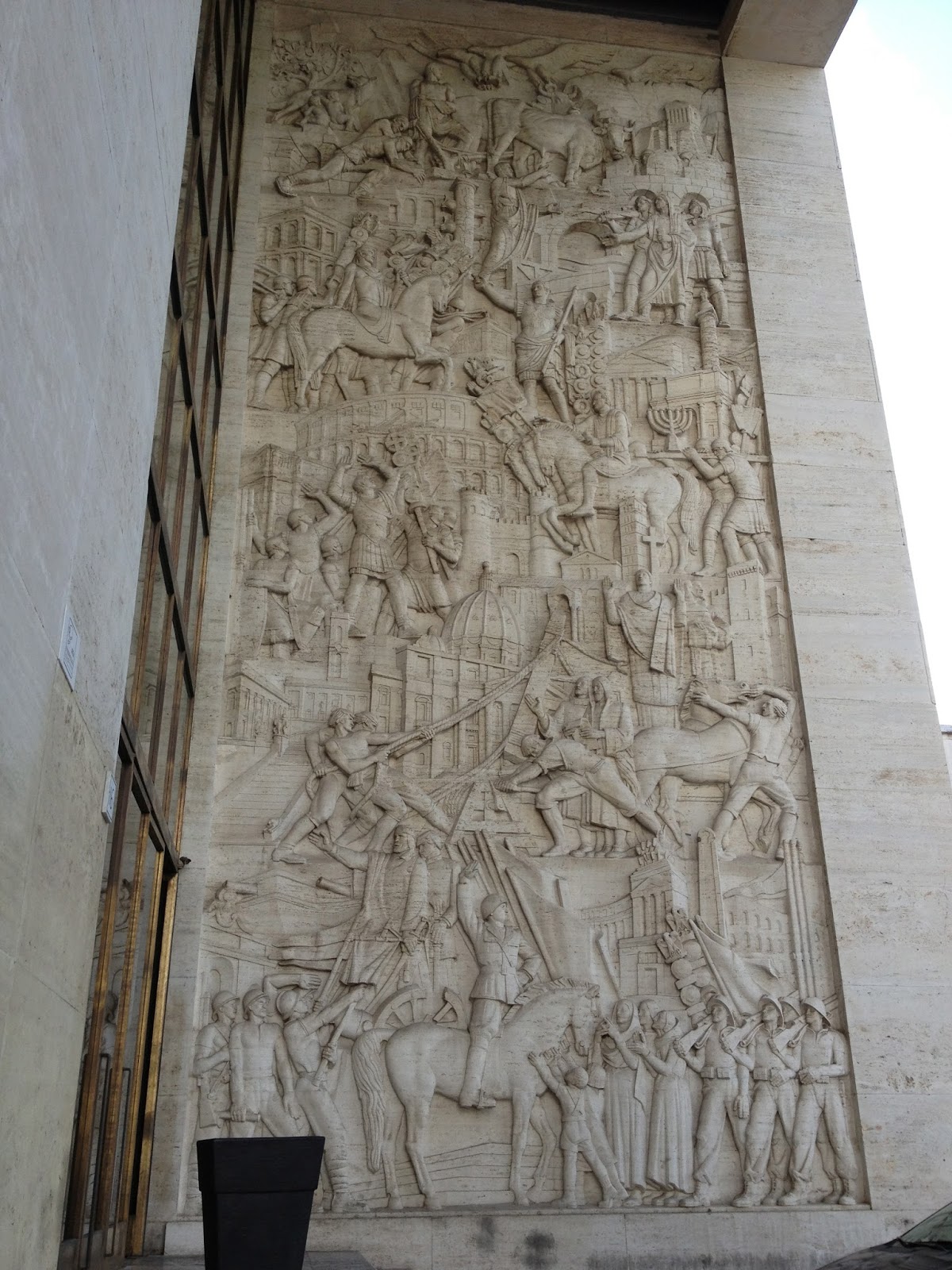
I also loved this huge relief that is supposed to evoke the reliefs on Trajan's Column, and that traces 2000 years of Roman history. You can see Mussolini down at the bottom, as well as Romulus & Remus (up top), St. Peter's, the Colosseum, the Pantheon, the Vittoriano ("wedding cake"), and even the menorah representing the sacking of Jerusalem.
"EUR" stands for Esposizione Universale Roma. The area was chosen in the 1930s as the site that Mussolini would use for the 1942 world's fair, where Mussolini planned to celebrate 20 years of Fascist rule in Italy. War intervened and the fair never took place -- but the name stuck. EUR was also intended to direct the growth of Rome towards the south-west and the sea, and to be a new city center. That did not happen either. But EUR is nevertheless interesting.
The EUR area has been called "Orwellian" due to its wide boulevards and white linear buildings. While that itself does not sound so appealing, some of the buildings are considered classics of 20th century rationalist architecture. Indeed, Mussolini chose several world-class rationalist architects to work on the project, and he wanted his magnificent suburb to be a symbol of the new times and of their historical continuity with imperial Rome.
The most stunning building -- which is considered a rationalist masterpiece -- is the Palazzo della Civita del Lavoro (Palace of Workers). This massive monument has become known as the Colosseo Quadrato, or Square Colosseum. You'll see why in the pictures. I gotta tell you: this was awesome. It's absolutely gleaming and it seems darn near perfect in its construction.
![]() |
| Just so you have a sense of scale, the "Square Colosseum" is over 160 feet tall. |
There are some other pretty cool buildings in the EUR area too.
![]() |
| The Santi Pietro e Paolo church (St. Peter and St. Paul), as framed by the giappanesi (Japanese) gardens of the pond in EUR. |
I also loved this huge relief that is supposed to evoke the reliefs on Trajan's Column, and that traces 2000 years of Roman history. You can see Mussolini down at the bottom, as well as Romulus & Remus (up top), St. Peter's, the Colosseum, the Pantheon, the Vittoriano ("wedding cake"), and even the menorah representing the sacking of Jerusalem.
![]() |
| Publio Morbiducci made this in 1939. |
![]() |
| Here is more of a close-up. |
Subscribe to:
Posts (Atom)