Friday, August 16, 2013

The Summer's Best Guest

I have enjoyed meeting up with friends, relatives, and former colleagues while here in Roma.  It's been tremendous to see familiar faces and to catch up on everyone's goings-on.  Without exception, I've loved it.  But there was a special visit this week that topped 'em all.

Longtime readers will recall my 2 trips this past spring back to NY for my 13-year old nephew Sam's bar mitzvah.  The tables got turned this week; Sam is here in Italy and spent the past 3 days in Roma.  Sam's wonderful maternal grandparents -- with whom I am very close -- are on a bar mitzvah trip with Sam to Rome, Florence, and Venice.  Their first stop was Roma, and we spent big chunks of Tuesday through Thursday together.  It was amazing to see the little guy and my sister-in-law's parents.

Sam quickly became a gelato expert during his first few days in Italia.  
It never did rain -- but we were prepared in the event it did!
Seeing Sam and his grandparents also underscored just how dramatically times have changed.  When my brothers and I got bar mitzvah'd, we didn't get no trips to Europe from our grandparents.  Our grandparents all told us, "Congratulations kid, now get a job.........!"

Thursday, August 15, 2013

Movie Review: "Il Buono, Il Brutto, Il Cattivo" ("The Good, The Bad, And The Ugly")

Have you seen this movie?  Have you seen it in the last 40 years?  Watch it again.  Seriously.

Seeing the Ennio Morricone concert a few weeks ago inspired me to "revisit" the famous spaghetti westerns on which Morricone collaborated with famed director Sergio Leone.  I put "revisit" in quotes because I thought I'd seen these movies when I was a young boy.  After watching "The Good, The Bad, and The Ugly" earlier this week, I'm not so sure.  Perhaps I did watch one or two of the others in this renowned Leone trilogy, but I definitely had not seen this one.  No way.  In any event, I loved it.


For those of you who don't know, the "spaghetti westerns" are a genre of films from the 1960s that were set in the American West, but were typically produced and directed by Italians -- and shot in Europe.  The Hollywood westerns had by this time pretty much died out.  But Italian filmmakers reinvigorated the genre with stylized versions of their own.  The movies often starred faded American stars who were on the way down, or an up-and-coming star, i.e., Clint Eastwood.  The best known and most highly regarded of the spaghetti westerns were directed by Sergio Leone, and scored by Ennio Morricone.  These movies in particular have become iconic, and the best known are the "Dollars trilogy" of "A Fistful of Dollars," "For A Few Dollars More," and "The Good, The Bad, and The Ugly," along with "Once Upon a Time in The West."

The spaghetti westerns generally garnered poor critical reviews when they were released, and Leone's movies are no exception.  Most American film critics looked down on them.  How can foreigners dare tread on the westerns, our most revered film genre?!?!?  That has changed over time, and Leone's spaghetti westerns have been reevaluated.  Many of them are now considered film classics.  "The Good, The Bad, and The Ugly" in particular shows up on many lists of the best movies ever, and Quentin Tarantino has called it  "the best-directed film of all time" and "the greatest achievement in the history of cinema."  I agree that it's up there.  

"The Good, The Bad, and The Ugly" is almost 3 hours long.  But it goes fast.  Although the movie is shot in a very spare manner (which reminded me of the style Clint uses in his movies decades later), although there are long stretches with little dialogue or action, and although the plot is as simple as can be, the film is riveting.  I was amazed at how gripping the drama felt and at how Leone created such a suspenseful effect with such a simple plot device.  Without giving too much away, the 3 leads are rivals looking for a buried treasure in the Civil War-torn West.  They don't trust each other -- for good reason -- but they also all need each other.  To me, the strategic interplay between Eastwood, Eli Wallach, and Lee Van Cleef felt like watching a litigation or a chess match unfold.  I loved that aspect of it.

I was surprised too by the movie's humor.  Indeed, while I never would have believed the following sentence if I'd read it before yesterday, I maintain it is true:  as great as Clint is as the uber-masculine hero in "The Good, The Bad, and The Ugly," it is Eli Wallach who steals the show.  You'll have to watch the movie to see if you agree.

What can I say about Morricone's score?  It's unbelievable.  The music in this film is most famous for the quirky unique tune that accompanies the main players -- primarily Clint -- and the dramatic high points of the movie.  That music is in fact both wonderful and effective.  (I say "effective" because it's hard to think of any movie in which the music plays such a prominent role in the story-telling.)  What surprised me most, however, was that, in addition to that famous part of the score, there are also some musical pieces in the movie that are more traditionally beautiful.  I think you hear echoes of the soaring and moving melodies that Morricone would later use in movies like Leone's 1984 mob classic "Once Upon a Time in America" (which is as good as "The Godfather," "The Godfather 2," and "Goodfellas"), "Cinema Paradiso," and "The Mission."

It is also just interesting to watch how Leone in the mid-1960s portrayed the American Civil War.  There are a couple of scenes with both Confederate and Union troops, and I was intrigued by what some of the characters say about war.

And I won't tell you the ending.  But when you see the fantastic conclusion to "The Good, The Bad, and The Ugly," you will instantly know that Tarantino wasn't kidding when he calls this film his favorite of all-time.

I give the movie 4 scoops of gelato.  If you haven't seen it, watch it.  If you've seen it but it's been 40 years, think about watching it again.  (Dad, you need to make Sam and Jack -- and Tori and Molly -- watch it!!)  I know I will be moving on to Leone's other spaghetti westerns now.  I'll let you know what I think.

Here's a great review by Roger Ebert.  This is not his original review from back in the day.  It's his revisiting of it in 2003:  www.rogerebert.com/reviews/great-movie-the-good-the-bad-and-the-ugly-1968.  Here's also the wikipedia entry on spaghetti westerns (en.wikipedia.org/wiki/Spaghetti_western), and on "The Good, The Bad, and The Ugly" (en.wikipedia.org/wiki/The_Good,_the_Bad_and_the_Ugly).

Monday, August 12, 2013

Other Bologna Attractions

There were lots of other things to see in Bologna.  Piazza Maggiore is where everyone hangs out.  And the place within Piazza Maggiore where everyone really hangs out is the Fontana del Nettuno.  This bronze statue of Neptune was sculpted in 1566.  


If the god of the sea is not enough of a draw for you, the 4 buxom sirens surrounding him in the fountain might catch your eye. 


Another superb site is the Abbazia di Santo Stefano.  This is not a church; it's an atmospheric medieval religious complex.  There are a couple of churches, a structure that used to be a baptistry, and some cloisters.  Most of the buildings date to the 11th century.


In this pieta scene, the placard at the top of the cross has text in a few languages.   One of them is Hebrew.  I asked a monk and he confirmed it.  

The Basilica di San Domenico is worth a gander as well.  There are a couple of statues by Michelangelo inside, and Mozart played the organ in this church.


There are additional picturesque piazzas and edifices throughout the city.   

Piazza Galvani
Torre Garisenda, one of the two leaning towers ("Le Due Torri") that are the city's symbols 

As If Missing The Cronut Craze Wasn't Bad Enough

I've been eating really well in Italy and in my other destinations.  I can't complain.  But, as someone who has always lived on the knife edge of what's new in our culture, missing out on a chance to get a Cronut while I was in NY hurt a little.  And now this……


Yes, it's a Ramen Burger.  

This is the new rage on the New York culinary scene.  What an explosion of creativity!  I hope they're still around when I return.  In the meantime, if any of you is lucky enough to have one, tell us how it is!  Better yet, come to Rome and bring me one or two.

More info on the Ramen Burger here:

http://www.thedailybeast.com/articles/2013/08/09/ramen-burger-s-inventor-talks-about-the-food-craze-eclipsing-the-cronut.html

http://www.theatlanticwire.com/entertainment/2013/08/ramen-burger-rightful-heir-cronut/67906/

Sunday, August 11, 2013

Bologna: The Original College Town - And The Land Of Porticos

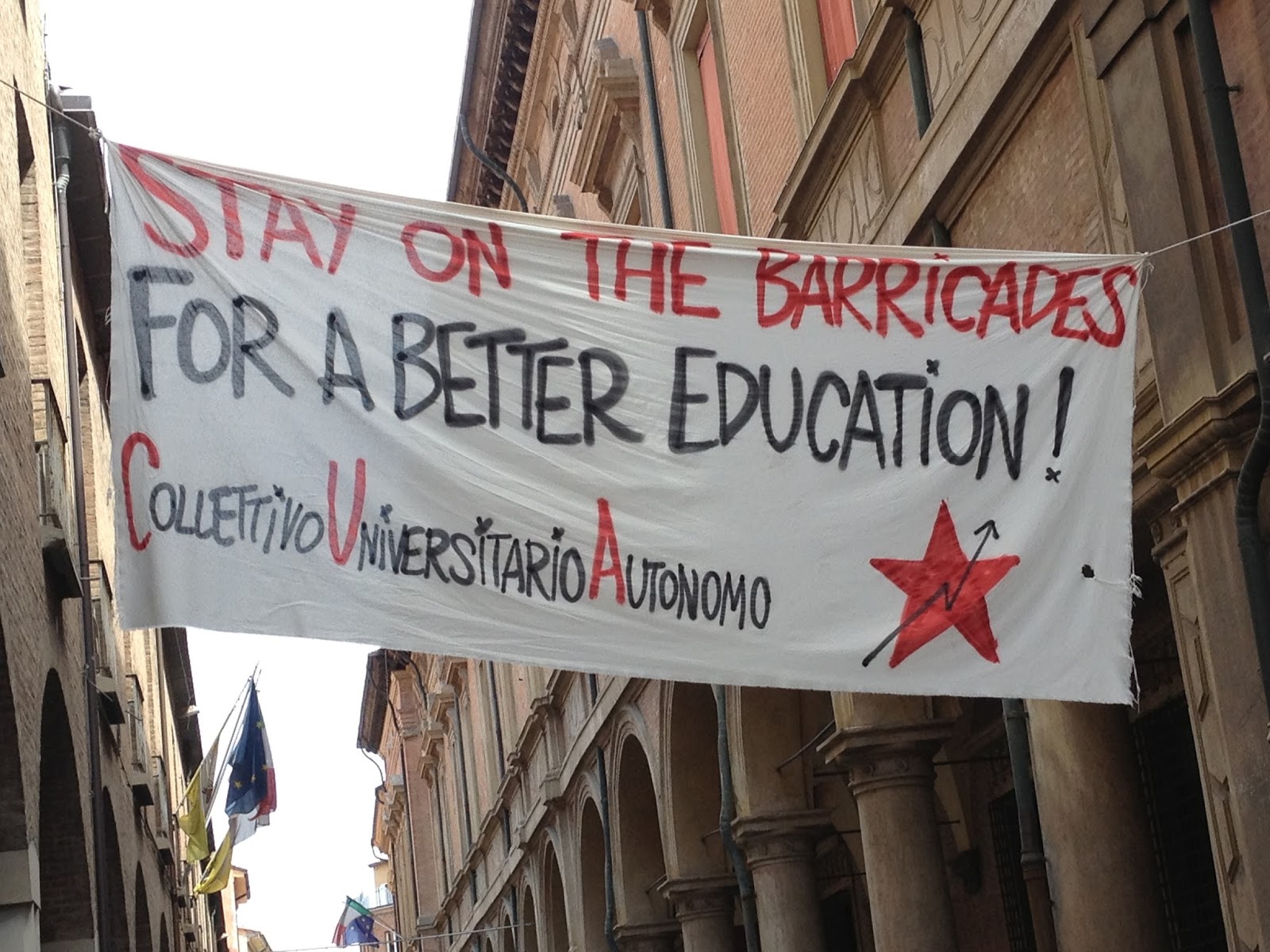
Bologna is famous for a few things, not just its cuisine. For one, it is home to the oldest university in the world.  That is why it is also called La Dotta, "The Learned One." 

The University of Bologna was founded in 1088.  Summer-time is obviously off-season.  But it is still fun to amble around the university quarter, which I think abuts what used to be the Jewish Ghetto.  The university quarter is very scruffy.  It is filled with graffiti, make-shift signs advertising apartments for rent, places to have beer and coffee, and loads of university buildings. 


Looks to me like this is part of the law school.  
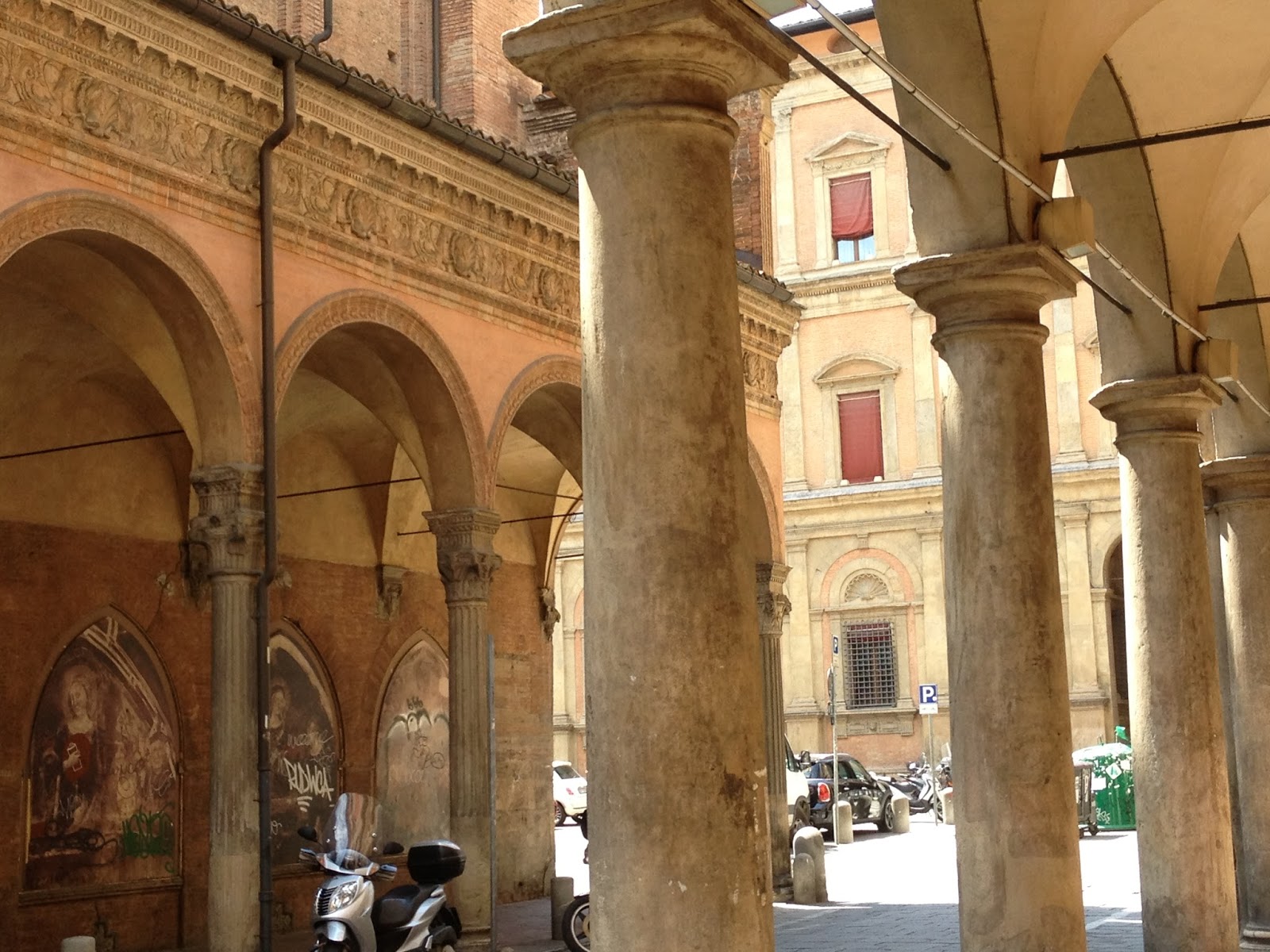
The other thing that is downright omnipresent in Bologna is porticos.  These are the portions of streets that are lined with arches under which you walk.  They are absolutely everywhere.  And some of them look good. 


A must-do on your next visit to Bologna is the long walk uphill to the Basilica Santuario della Madonna di San Luca.  It's a bit of a workout - which you need given all the food - because you have to walk along the longest portico on earth.  There are 666 arches that hold the portico aloft.  (You can take a bus that gets you half-way there; unfortunately, it drops you off just where the incline begins.)

If you do this in summer-time, you'll be drenched by the time you get to the basilica. It's worth it though. You have some incredible views and the church itself is quite nice.

This is where the bus lets you off and where you start the long walk up.


Finally, you get to the top.  It looks good from there.   

Saturday, August 10, 2013

On Taking Suggestions From The Front Desk At Your Hotel

I planned on heading back to Roma at some point on Saturday.  But I was pretty flexible. I really had no agenda for Saturday and, between Thursday afternoon and Friday, I'd hit all the things I considered "must sees" from Lonely Planet and the NYT 36 Hours in Bologna.  I therefore on Friday night asked the guy at the front desk - who'd been helpful so far - what he recommended.  He mapped out a nice walk outside the city center that would take me uphill to a beautiful church with a wonderful view of the city below.  He also gave me a route to take on the walk back that passed a few churches he said were unique and famous for the Bolognese.  None of these sites is in the NYT or Lonely Planet guides.

Well, wow, I'm glad I asked.  I followed all of Roberto's advice and it turned out to be a surprisingly charming day of sight-seeing. 

The San Michele in Bosco church should be in the guidebooks.  It offers magnificent views of the city center. 


The church is nice too. 


San Michele in Bosco is south of the center and outside the city walls.  But it's really just a 30 minute or so walk from the heart of the city.  It's definitely off the tourist route though.  I was the only one there at 10:30-11:30 on Saturday morning.  

The other places Roberto said to go were good as well.  The Chiesa di Santa Lucia was in particular a nice spot.  I've certainly never seen a church with quite this type of design.  The doors were locked, so I could not see the interior.  But I was happy with the exterior alone.  Look at the close-ups so that you can see the material from which the church is made.


St. Giovanni in Monte was worth a quick stop also.


I couldn't really view the last church that Roberto had suggested.  It looked to me like Santa Maria dei Servi was undergoing massive construction.  So be it.  While wandering, I found the funniest museum of women's clothing I've ever seen.  I only walked in because the museum was inside a little tiny palace that caught my eye and was very pretty.


When I came downstairs from snooping around what might've been fancy high-end office space, the man downstairs informed me that the upstairs was private, but I was welcome in his museum on the ground floor.  It was several rooms filled with musty old paintings on the walls, and mannequins of women's styles for work and formal-wear in the 19th and 20th centuries.  The humorous thing was that I tried to walk out a few times.  But the dude kept saying, "did you see this room....?" and then he'd guide me into another room that looked just like the previous 4, but where the dresses were from 30 years later.  I didn't have the heart to tell him that he was a docent in the most boring museum in Europe!

Anyway, you can pass on this one - I should have too; after all, Roberto had not mentioned it.   

Cucina Bolognese

The food in Bologna did not disappoint. I think that if I was on death row and I could spend my last day wandering the streets eating somewhere, I might pick Napoli ahead of Bologna. But that's not a dig on Bologna. La Grassa ("The Fat One") lived up to its reputation.  

The one thing I absolutely could not keep my eyes - or hands or mouth - off of was another of those to-die-for regional pastries. This one is called a "Tortine Bolognesi con le Tagliatelle." Hard to describe - but here are some pics, both inside and out:


Basically, it is a dense hockey-puck-shaped brick of grainy pasta (I think) that is loaded up with sugar and topped with thin crispy noodles. It doesn't have an intense flavor - it's mild. But, good god, it was amazing. I tried to find out more about this specialty, but my research did not turn much up. This article is the closest that I found, www.fiordifrolla.it/torta-di-tagliatelle.html.

Lots of other fabulous food too. Had to have the famed "tagliatelle al ragu" - "ragu" is what we usually call Bolognese sauce back home - on my first night, and then kept indulging on other pastas, mortadella and other meats, pastries, the most famous coffee in Bologna, and vino.
The big "ragu"
Lunch at Tamburini, Bologna's most packed traditional Italian deli

This is Terzi - Bologna's most famous shop for coffee/tea.  

Must go for long run when I'm back in Roma on Sunday (emphasis intended).